

During 2018 the government actioned US tariffs to cut back on goods flowing into the US from elsewhere. These measures were initially aimed at particular goods (steel, aluminum, solar panels and washing machines), then pushing back on importation of goods from China overall. The Trump administration’s aim was to use these tariffs to aggressively reduce offshoring of manufacturing US jobs, providing an incentive to return them to the country. However, these tariffs have an impact that goes well with this single purpose. Read on to learn how much broader and deeper the effects of the US tariffs have been.
 Several effects from US tariffs have come about to China and sea freight
US-China trade war and the US tariffs
The US-China trade war began in the first months of summer 2018, when both countries increased import taxes on around $50B-worth of the other’s products. It proved impossible to settle the differences relating to such matters as IP rights and trade balances. This resulted in the commercial alliances between the two countries becoming increasingly fraught.
In September 2018 the government brought in further US tariffs on US$200B in Chinese goods being brought into the US. China responded in kind, setting tariffs on US$60B of US goods being imported into China.
US tariffs on China increased quickly with two significant increments
Although these import taxes were to have increased in January 2019 from 10% to 25%, early in the month before it was decided to put a hold on any reprisals until March 2019.
This stand-off remained in place until June 2019, when the US increased the tax from 10% to 25% on imports from China. In response, China then raised its taxes on a subgroup of the goods on which tariffs were already being levied.
Then US tariffs on China were greatly expanded
The situation deepened in September 2019. At that time the US set import taxes of 15% on a major subgroup of the rest of the US300B of goods imported into the US from China that were not already being taxed.
There was another expansion in December 2019. Indeed, over the course of 2020 this situation – referred to as the ‘US-China trade war’ – has continued to grow.
Effects on trade and sea freight of the US tariffs on China
Not surprisingly, from the moment they were imposed the US tariffs on China caused an expected decrease in US-China trade and sea freight. There is no indication this decrease will change in the near future. Without some drastic policy change, sea freight will remain under duress for the foreseeable future.
China imports decreased but increased with other Asian countries
Over the period, China-US shipments have constantly been smaller than previously. In the first 10 months of that year the volume of goods shipped by container from China to the US dropped by 7.9%.
The trade war has made it clear that stability and certainty is not something that can be relied upon. Indeed, relying on any one region for resourcing has as many negatives as positives. Southeast Asian countries have gained from the conflict due to the resultant boost in demand for their goods and services.
This escalation in trade means greater development in those countries to ensure their infrastructure can meet the demand. This is all very positive for the sea freight industry.
Changing import source from China likely to remain
Importing companies have to make extensive arrangements when moving their sourcing to a more competitive country in Southeast Asia. Changing to an alternative source exposes the importer to a number of potential hazards. For example, the alternative source country will have:
- Different parameters to tariffs and laws
- Pose new manufacturing quality issues
- Lower service levels and capability for energy and transportation
- Lesser government stability
- Reduced levels of manufacturer availability
Once these hazards are understood and overcome, it is unlikely that importers will consider switching their sourcing back to China while US tariffs remain. It is likely the process for the importer to return to China will require extensive arrangements. A compelling case to repeat such effort might only become apparent if US tariffs were to be eliminated.
US imports with Asia has decreased as a whole
Across the board, there has been a year-on-year (YoY) decline in goods being imported from Asia. Irrespective of the growth in Vietnam’s business, the YoY 20ft shipping containers (TEU) numbers have dropped by 1.3%. Comparing the volume of shipping imported from the top 10 Asian countries for 2018 to 2019, from January to October, clearly illustrates this substantial change.
US west coast ports have traditionally been the landing places for goods arriving from Asia. These, however, have been hard-hit due to a 1.5% reduction in inwards goods handled. 2020 is large uncharted territory, given the coronavirus pandemic. There are also other aspects and considerations that have in other ways impacted on US-China trade.
Vietnam has the largest gain in trade
In volume alone Vietnam has clearly done best from the trade face-off. It has recorded a 28.6% jump in output over January to October 2019 period compared with the previous year. It is, however, important to recognise that this jump in volume is not solely attributable to manufacture in Vietnam. Other factors that must be considered include endeavouring to avoid the import taxes, in respect of which the Vietnam government and Customs set and enforced stringent controls, by switching the originating region.
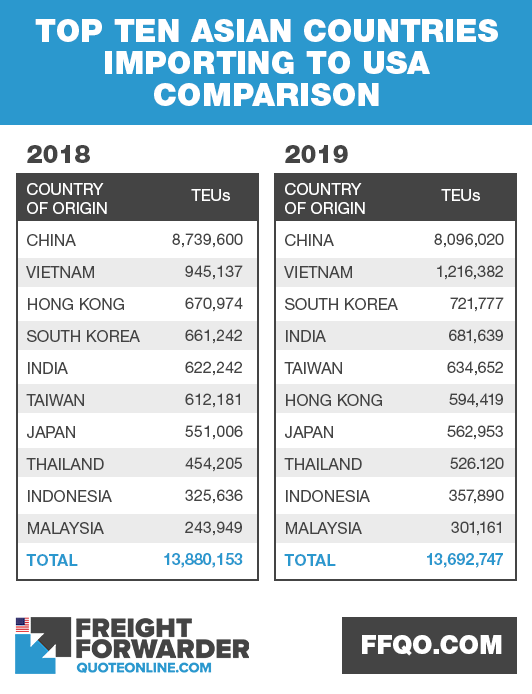 Top ten Asian countries importing to USA annual comparison (January to October)
US tariffs increased the cost of sea freight
Overall, the US tariffs have caused an increase in shipping costs. When the tariffs were first being applied, an initial price spike in sea freight occurred from preemptive trading. Once this spike passed, the US tariffs caused a geographic shift of shipments – particularly imports – that significantly decreased sea freight between the US and Asia. As this shift is likely to continue and accelerate, the reduction of economies of scale will lead to further increases in costs.
There are other factors driving up the costs in shipping. These include the need to become more sustainable and environmentally-friendly, and the need for investment in technology to generate industrial efficiencies. However, the US tariffs are the most significant contributor.
Contact us for help on US tariffs and trade with China
Get the advice you need on US tariffs and avoid needless holdups by teaming up with an expert and acknowledged leader in sea freight. We are proud of our record in fast turnaround on quotes that meet your requirements, provide the information you asked for and ensure you don’t get any shocks later. Whether you’re shipping into or out of the US, with our help you can be sure it will go well.
We would be happy to assist you in working out the best solution for your sea freight trade with China to the US. Contact us online and send a message. You can even message us on Facebook for assistance. We have much expertise to offer.


