

Businesses looking to bounce back from the Covid-caused freezes have major obstacles to deal with in the air and sea freight industry. The CEO of the world’s largest supply line organisation said this industry has been troubled globally by major reductions and cutbacks, and long periods of interrupted trade.
 Sea freight full steam ahead as airfreight tightens
Major obstacles ahead for the air and sea freight industry
In responding to a recent question, Frank Appel, head of Deutsche Post AG which is part of DHL, said that cargo transport shipments will grow considerably as the US and Europe begin increasing manufacturing plant output and restart warehousing and retailing operations.
Frank said, however, there will be a general shortage in every aspect. This will take more time to overcome, he said, particularly for more expensive items such as machinery, tools and computerized products, and componentry generally freighted by air, often via commercial airlines. Air carriers cut huge numbers of services due to the spread of Covid globally. The amount of space available for carrying goods by air is likely to be tight for a while. This is because it may take some time before passenger air services justify putting those flights into the air. This may cause organizations to rethink their shipping options for a while, possibly freighting by sea or rail rather than by air.
Frank said there will be some delay between the time isolation restrictions end to when commercial flights are once again fully booked. He commented that, “While individuals are not permitted to move around, what company would put its planes in the air? No company at all – which severely constricts available space.”
Air and sea freight costings and pricing have soared
The confluence of very low numbers of planes in the air and record low market interest have radically changed the air transport industry. Costings and pricing have soared as freight organizations look for alternatives such as container ships and commercial cargo-only planes in order to ensure vital deliveries such as health care or pharmaceutical goods and products. A number of air companies have been and are using their planes to carry freight in these times when they cannot carry people.
There is, however, concern that even after infection rates ebb, people may still be reluctant to travel by plane. For instance, as reported by IATA, intra-China air travel is at approximately 40% of what it was before the pandemic began.
Major interruption have occurred worldwide for air and sea freight
DHL, like many of its competitors, has suffered from the worldwide major interruption to logistic networks. This is because the need for freight products crashed with the collapse of global commerce and sharp drops in trade. Very recently, Deutsche Post of Bonn, Germany, pulled back from its 2020 advice, saying that because of Covid it suffered a Eur200M (US$216M) loss in pre-tax/pre-interest revenue in February and March.
Frank stated that airfreight capacity may lag a general return to business and hinder rapid recovery. Statements like this, coming from the Chief Executive of the German express and logistics group Deutsche Post DHL, flag a concern. On an optimistic note, the company stated they are seeing some heartening growth in their dealings with China, USA and Europe, which seem to be less affected by the pandemic.
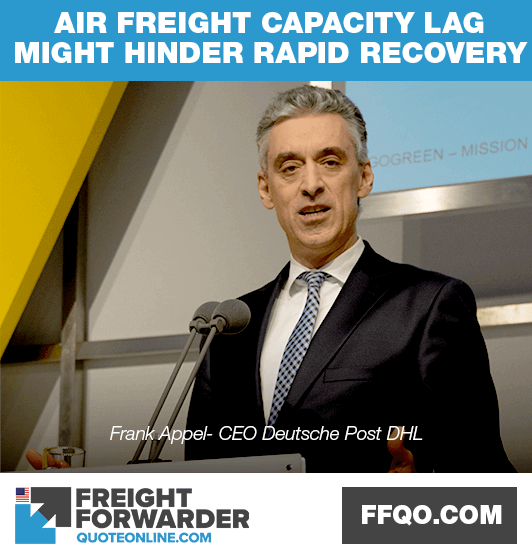
Airfreight capacity might lag a return to business and hinder a rapid recovery
Expect major impacts on supply chains
Frank said that DHL’s cohort of 250-plus planes specifically designed for carrying freight – part of its Express Division – are in constant use. When the pandemic first took hold, DHL’s freight-shipping branch acted without delay to ensure access to shipping space by making arrangements with air freighting companies.
DHL is a leading purchaser of freight capacity on passenger transport planes, however, Frank said, notwithstanding all it has done there is still a huge shortfall in cargo space on passenger planes. This will, he said, be increasingly evident once business goes back into production and the retail sector reopens.
“Clients will need to consider their logistics network and expect major impacts on supply chains,” said Mr Appel, “taking longer in inventory run-up, considering whether they have sufficient product available, and then booking space on vessels, regardless of whether the goods are higher-priced,” He said, “There is considerably more space on the ships than on the planes.”
Globalization and offshoring not expected to decline
Even with the lockdowns and worldwide lack of goods resulting from the virus, Frank does not believe globalization will decline or that offshore manufacturing among industrial and developed countries will return to domestic production.
Rather, businesses will probably ensure their logistics networks are stronger and more robust, by distributing their manufacturing plants throughout a number of regions, rather than having just one facility in China.
“Other locations might also be utilized; however it won’t all be shoreside, as that wouldn’t be cost-effective,” said Frank. He also stated that people believing that globalization has reached its end do not grasp customer motivation or on what commercial decision-making is based.
Key considerations when choosing sea freight over air freight
We show hereunder some matters your organisation should consider when choosing between shipping by plane or ship. We’ve thought about the various considerations, including swiftness and exigency, pricing, dangers, legal responsibility, ecological considerations and dependability. Rather than looking at these aspects individually, we believe it is vital to take the holistic view, seeing how the whole will affect your organization.
Shipping transit time
Shipping by air is undoubtedly swifter than by sea, so if your goods need to arrive at their destination quickly and you are prepared to cover the additional costs associated with freighting by plane, then this is the better choice. Bear in mind, however, as included in our China blog, goods transported from Shanghai to Australia by ship can arrive in under two weeks! If you are amazed by this, you need to make sure you are looking at the shipment duration your shipping company has provided rather than basing your opinion on an assumption that shipping by sea is the slow option.
Overall cost of freight
As discussed previously, contingent upon what you are prepared to pay (particularly regarding exigency), paying additional costs for shipment by air may well be worthwhile in order to ensure fast delivery of your goods. Conversely, if speed is not an issue, shipping your goods by sea is more economical. It is also imperative to weigh up, side by side, the insurance costs for shipment by air, or by sea if you take out marine insurance.
Service reliability
Shipping by plane can be held up by inclement weather, or other unusual conditions such as labor protest. An example of this BA’s grounding of its freighting activities in September 2019, because its pilots went out on labour protest. Other examples are the possibility of structural or mechanical problems on planes, or a plane having to make a sudden/unplanned landing. Such situations are, however, very unusual, and shipping by air is deemed among the most reliable and least risky ways of freighting goods.
Shipment by sea is also dependable, with today’s ships constructed to handle the most severe conditions at sea. Even so, bad weather and water movements can impact on arrival times. Also, one very unusual – fortunately rare – cause for concern is piracy. Speaking with your shipping company about these matters is vital to make certain you have the necessary insurances in place to protect you should there be damage to or even total loss of the cargo you have shipped.
Comparing the differences
Other points of difference regarding the two ways of shipping goods include legal responsibilities to the purchaser, goods on hand, available space on plane or ship, and ecological considerations.
- Shipping by plane is much quicker, but generally costlier, than freighting by sea
- While both are dependable shipping options, both may be subject to unforeseen holdups
- Shipping by sea is generally considered better for the environment than shipping by plane
- Heavier loads are generally more suited to shipment by sea.
Before deciding on a course of action, it is essential to weigh up the need for speed, your legal obligations to your clients and market considerations such as what your competitors are doing.
 Key considerations when choosing sea freight over air freight
Contact us for help on sea freight
Avoid needless holdups and minimize organizational concerns by teaming up with a highly respected leader in freight shipping. We are proud of our record of fast turnaround on quotes that meet your requirements, providing the information you asked for and ensuring you aren’t in for any shocks later. Regardless of whether you’re shipping into or out of the US, with our help you are assured it will go well.
We would be happy to assist you with your bills of lading for international freighting to or from the US. contact us online and send a message. You can even message us on Facebook for assistance. We have much expertise and are happy to help.


