

In 2018 the US government raised a series of tariffs to better protect its domestic economy and reduce imports coming in mostly by sea freight. These included raw materials such as steel and aluminum, as well as on manufactured goods like washing machines and solar panels. US tariffs were then expanded and applied specifically to goods imported from China.
Through September to December 2018, after the import tax was announced, there was a huge preemptive increase in pricing. The intention was to overcome the rises in tariffs on goods coming into the US ex China. This resulted in greater volumes and increased shipping costs over what would usually be a quiet time for sea freight. This is because the majority of import companies were focused on doing their EOY inventories. Once this period passed the price spike appeared to settle down.
For more on the US-China trade war and US tariffs.
As time went on, however, these tariffs continued to increase, dramatically driving up the cost of China imports. This has caused broad and deep shifts in the global economy, particularly on sea freight. Read on to find out what sea freight has been affected.
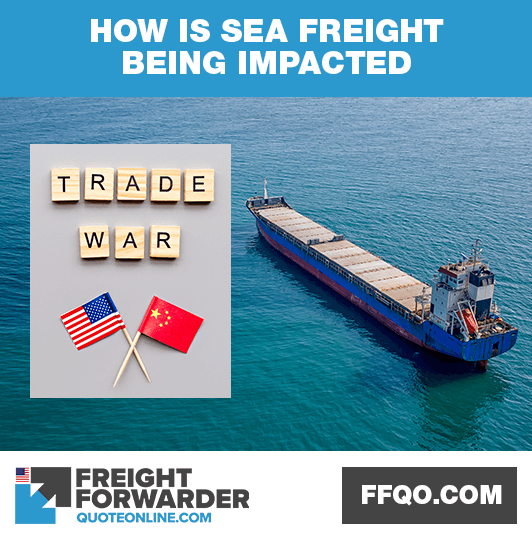 How the US-China trade war and US tariffs impacting sea freight
US tariffs have caused an overall increase in shipping costs
Shipping costs from China during 2019 were approximately $1,000 more per average shipment than in 2018. From when the current contract period began in Q2, and other than during a number of disparate weeks, spot shipping costs have been under those of fixed. What caused this?
Decrease in volume from geographic shift
The way sea freight has changed since the latter half of 2018 and 2019 will speed up even more in 2020. A significant number of importers have organised, or are in the process of organising, their shipments to come from other countries. Much of the change has been to other Southeast Asian countries. Overall, however, there has been a drop in imports ex Asia.
This means that for the time being China will remain in place as a pre-eminent global manufacturer. The direction, however, is clear. Sooner or later other regions will drive their capacities up and to the fore. Also, the US domestic industry is rapidly growing.
Growing uncertainty and predictability
Prior to the Covid-19 pandemic, no shippers disclosed any major reductions in carrier capacity for 2020. Indeed, it seemed the cost of sea freight might stabilize. Rising tensions, however, between the US and China made the market difficult to predict.
Once the pandemic struck there was a marked decrease in demand and factories were forced to stop production. During this period, shippers drove rates up. It is unknown at this stage how the pricing will continue, but it is thought the coming year will not be the best for sea freight and importing from China. The fundamental problems still exist and a possible downturn in the US will only exacerbate these.
US tariffs are not the only factor affecting costs in sea freight
It is not US tariffs alone affecting costs in shipping. There are external pressures, such as the need to become environmentally-friendly and more sustainable. There are also costs, such as technology investment, that will provide operational efficiencies.
The shipping industry will become more sustainable and environmentally-friendly
Together with the IMO 2020 ruling, the company is executing other measures to compel vessel owners to invest in new plant by 2024. This will cleanse the water used for ballast in their vessels and entails investment of approximately $50B.
In 2018, the IMO made a decision to lower the marine transport industry’s carbon footprint by 50 percent by 2050. In aggregate, all working vessels create two percent of the world’s carbon, 13 percent sulphur and 15 percent nitrogen oxide discharges respectively. The new restrictions on sulphur emissions will lower the incidence of asthma in children. It will also lower early mortality rates caused by the high levels of sulphur currently utilised in vessels.
Technology will not disrupt sea freight, but it will make it more efficient
It is believed that the sea freight industry – contrary to what was previously thought – will not be negatively affected by automation as other industry sectors have been, at least not initially. Typically, implementation of technology can be done on a continual process improvement and bring value on an incremental basis. Such improvements can improve transparency for clients and other parties involved in the supply chain. However, to achieve the ‘next level’ of automation will require considerable investment in technology and this investment comes at a significant cost. This cost will be partly covered by increased sea freight costs.
Consolidation of sea freight and distribution will re-balance industry
Working for unification over a number of years, large shipping companies have at last begun to manage distribution in a more efficient manner as part of their service. This has resulted in a reduction in the holding of cargo in ports, but its effect on the industry is not well understood.
This consolidation does seem helpful to an extent, but the main problem – the disparity between supply and demand – has not seen resultant reductions in sea freight cost. On the contrary, smaller shipping companies are now at risk of being unable to compete by offering consolidated sea freight services like the larger shippers. Fewer shipping companies means fewer service providers and a monopolized marketplace and higher prices.
Reducing sea freight costs from China
Although the US tariffs are increasing the cost of sea freight by reducing the volume of trade, there are several other major factors at play. To keep your sea freight costs from China down, get the advice you need on shipping and US tariffs.
Contact us and avoid needless holdups by partnering with a renowned market leader in US sea freight. We have a record of fast turnaround on quotes that meet your requirements and proven ability to provide the information you need. Our team is upfront and ensures you don’t get any surprise costs later. With our help you can be sure you get the shipping you need, whether you’re shipping into or out of the US.
We offer experience and expertise and are happy to assist you. Send us a contact us online message. You can even message us on Facebook for assistance.


