

For years, small-to-medium importers relied on the Section 321 exemption to bring goods valued at under $800 into the United States duty-free. However, the regulatory environment has undergone a historic shift. As of 2026, the De Minimis exemption has been suspended.
This means that whether you are shipping a single $50 parcel or a $50,000 container, your goods are now subject to federal duties and the new Section 122 global surcharge. Success in the US market now requires precise landed cost modeling that accounts for these universal fees from day one.
Navigate this guide to learn how to adjust your operations when exporting to the US in 2026.
- What is the US De Minimis exemption?
- How was the US De Minimis Exemption suspended?
- Process to import goods into the US
De Minimis exemption suspended and its impact on US importing
What is the US De Minimis exemption?
To understand the current complexities of US importing, it is important to first understand the legacy of Section 321. This statute served as the foundation of the De Minimis environment that fueled the e-commerce boom for more than a decade.
What was Section 321?
Section 321 is the common shorthand for Section 321(a)(2)(C) of the Tariff Act of 1930. This provision established the De Minimis threshold, allowing low-value shipments to enter the United States with minimal friction.
Under this provision, goods valued at or below the threshold were classified as informal entries. This status granted them two major advantages.
Duty and tax immunity
Shipments could clear customs without incurring federal duties or taxes.
Streamlined Processing
These shipments required significantly less paperwork than formal commercial entries, allowing for faster release by US Customs and Border Protection (CBP).
The power of the $800 threshold
While the informal entry threshold for many goods is $2,500, the De Minimis benefit was capped at $800. In 2016, Congress raised this limit from $200 to $800, a move that effectively opened the floodgates for international e-commerce.
This higher threshold allowed businesses and consumers to purchase a substantial volume of inventory and consumer goods from global markets without the burden of additional duties or taxes.
Who benefited from the exemption?
The Section 321 era created a highly competitive, “frictionless” market for three main groups.
US Businesses
Small retailers could source inventory from abroad and significantly reduce logistics costs by keeping individual shipments under the $800 threshold.
US Shoppers
Consumers could purchase directly from international brands, with shipping fees often being the only additional cost beyond the purchase price.
Non-US Retailers
International companies gained a significant competitive advantage in the U.S. market, as they could ship directly to American customers without passing on the cost of duties.
While these benefits once helped drive the growth of modern e-commerce, the suspension of Section 321 has transformed these savings into mandatory costs that businesses must now account for through a robust landed cost modeling.
Standard restrictions of Section 321
Statutory limitations defined the scope of Section 321 to ensure that only legitimate low-value shipments qualified for expedited treatment.
Daily limit
Each recipient was limited to one Section 321 shipment per day.
Ineligible commodities
Certain goods were always excluded from this expedited process, regardless of their value. These included products subject to Anti-Dumping Duties (ADD) or Countervailing Duties (CVD), as well as goods regulated by agencies such as the FDA, USDA or FSIS that required physical inspection before release.
How was the US De Minimis Exemption suspended?
The landscape of American trade changed dramatically between 2025 and 2026. What was once a simple $800 duty-free threshold under Section 321 of the Tariff Act of 1930 has been dismantled in favor of greater visibility and universal duty collection.
Initiation of the suspension on 2025
The shift began on 2 May 2025, when Executive Order 14256 removed de minimis treatment for all goods arriving from China and Hong Kong. This initial action addressed concerns related to supply chain security and the influx of unscreened parcels.
The global trade community felt the full impact of this shift on July 30, 2025, when Executive Order 14324 extended the suspension to every country worldwide. By August 29, 2025, the duty-free pathway had officially closed. CBP Bulletin 66065494 confirmed that any request for de minimis entry would be rejected. As a result, every package, regardless of its value, required formal entry and duty payment.
Arrival of the new standard on 2026
Regulatory refinements continued into the new year. On February 28, 2026, the transitional duty collection period for international postal shipments concluded. Currently, only the ad valorem duty method is permitted for postal carriers and certified parties.
Legislative intent remains clear. The One Big Beautiful Bill Act (OBBBA) provides a statutory framework for making these changes permanent by July 1, 2027. Importers must now recognize that the era of duty-free small parcels has been replaced by a more rigorous data-driven customs environment.
| Date | Milestone | Impact on importers |
| May 2, 2025 | Executive Order 14256 | De Minimis treatment ends for China & Hong Kong |
| July 30, 2025 | Executive Order 14324 | Global suspension of duty-free treatment signed |
| Aug 29, 2025 | The Dark Date |
Full suspension takes effect All sub-$800 goods pay duty |
| Feb 24, 2026 | Section 122 Implementation | 10% global surcharge becomes baseline cost |
| Feb 28, 2026 | Postal Transition | Ad valorem duty method becomes mandatory for mail |
| July 1, 2027 | OBBA Statutory Deadline | Potential for permanent legislative elimination of Section 321 |
Timeline for how US De Minimis Exemption was suspended table
What are the economic consequences of Section 321 suspension?
Landed costs for small-value shipments have increased dramatically since the elimination of the $800 de minimis threshold. Importers must now account for the applicable HTS duty rate in addition to the 10% Section 122 global surcharge that took effect on February 24, 2026.
Price-sensitive categories such as fashion, electronics, and home goods face the greatest pressure. A product that was previously valued at $50 and imported duty-free may now incur not only additional tariffs but also administrative fees ranging from $25 to $75 per shipment. These fixed brokerage costs often exceed the value of the duties themselves, forcing many businesses to abandon just-in-time delivery models in favor of larger, consolidated shipments.
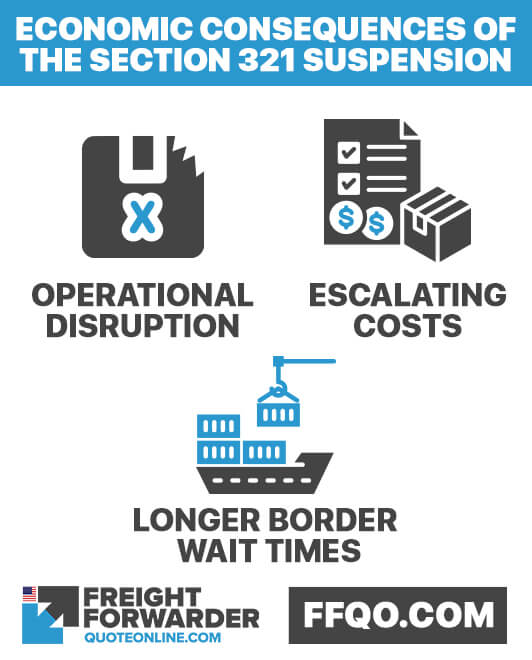
Economic consequences of the section 321 suspension
Operational disruptions
Customs clearance timelines have expanded as the Automated Commercial Environment (ACE) processes a massive surge in formal filings. Formerly exempt shipments that cleared in hours now typically face processing windows of two to four days.
Escalating operational and administrative costs
Prior to the suspension, low-value packages could enter the United States duty-free with minimal paperwork. With the de minimis exemption gone, every individual overseas shipment requires a formal customs entry, detailed 10-digit HTS codes, and full duty payment.
This shift drastically spikes administrative overhead and per-shipment costs. Customs clearance timelines have expanded exponentially as the Automated Commercial Environment (ACE) processes this massive surge in formal filings. Small businesses without established relationships with licensed customs brokers are finding their shipments rejected or delayed indefinitely, making success in this environment dependent on utilizing Delivered Duty Paid (DDP) terms and pre-validating product data weeks before the cargo reaches the United States.
Increased border wait times
Scrutiny at the border has reached unprecedented levels. Every package now requires a 10-digit HTS classification, leading to a higher frequency of inspections and documentation requests. Small businesses without established relationships with licensed customs brokers are finding their shipments rejected or delayed indefinitely. Success in this environment depends on utilizing Delivered Duty Paid (DDP) terms and pre-validating product data weeks before the cargo reaches the United States.
| Impact Category | Operational Reality |
| Direct Cost | Minimum 10% Section 122 surcharge plus base duties |
| Admin Fees | Brokerage and filing fees now apply to every sub-$800 parcel |
| Lead Times | Clearance windows have shifted from hours to multiple days |
| Data Requirements | Mandatory 10-digit HTS code for every SKU in a shipment |
| Postal Shipments | Ad valorem duty collection is the only permitted method for mail |
Impact summary for 2026 US importers from De Minimis suspension table
Process to import goods into the US
Proper entry of goods and strict compliance with customs regulations are critical to success in the 2026 US import market. Universal duty collection and mandatory 10-digit HTS classifications have made self-importing increasingly complex for modern businesses.
Navigating the Automated Commercial Environment (ACE) without professional assistance can often result in shipment rejections, costly delays, or liquidated damages claims. Our detailed guide for first-time importers to USA provides an essential framework for understanding and meeting these 2026 requirements.
Mandatory 10 digit HTSUS classification
Precision in product classification has evolved from a best practice into a mandatory requirement for all entry types. Every commercial shipment entering the US must now be assigned a full 10-digit Harmonized Tariff Schedule of the United States (HTSUS) code.
The first six digits of the code follow international standards, while the final four digits provide statistical and duty-related information specific to the United States. Assigning the correct code is essential because it determines the applicable duty rate and identifies any Section 122 surcharges that may apply.
Classification errors frequently trigger electronic warnings within the Automated Commercial Environment (ACE) system, resulting in cargo holds, entry rejections, or significant civil penalties in the heightened compliance environment of 2026.
Authorized filing via ACE for all shipment values
ACE now serves as the exclusive portal for authorizing all import declarations, regardless of shipment value. The streamlined Section 321 process, which previously allowed manifest-only entry for qualifying low-value goods, no longer exists for commercial shipments.
Every order now requires an authorized filer to submit either a formal or informal entry. This change ensures that US Customs and Border Protection (CBP) maintains complete visibility over the billions of packages that previously entered the country with limited oversight.
As a result, businesses should establish formal relationships with licensed customs brokers to manage electronic filings and ensure all required data elements are submitted accurately before cargo arrives in the United States.
Mandatory CPSC eFiling starting July 8 2026
The Consumer Product Safety Commission (CPSC) is transitioning to a real-time entry surveillance system. Effective July 8, 2026, importers of regulated consumer products must electronically submit product certificate data through ACE at the time of entry.
This requirement applies to approximately 600 designated HTS codes, including those covering toys, children’s apparel, electrical appliances and furniture. Importers must provide specific data elements for each shipment, including the date of manufacture and applicable safety certification information.
Failure to provide the required certificate data at the time of filing may trigger electronic warning messages, often resulting in CPSC examinations and cargo holds that can extend for up to 60 days.
Section 122 global surcharge implementation
Financial planning for US imports must now account for the Section 122 global surcharge imposed on most imported goods. This measure was initially introduced at 10% on February 24, 2026, and later adjusted to 15% for many product categories.
While certain exceptions may apply to goods originating from USMCA partners such as Canada and Mexico, most consumer products remain subject to this additional duty. Success in the 2026 import environment requires accurate landed cost modeling that incorporates these charges from the earliest stages of procurement.
Businesses that continue to rely on outdated duty-free pricing models risk eroding profit margins and undermining long-term competitiveness in today’s trade environment.
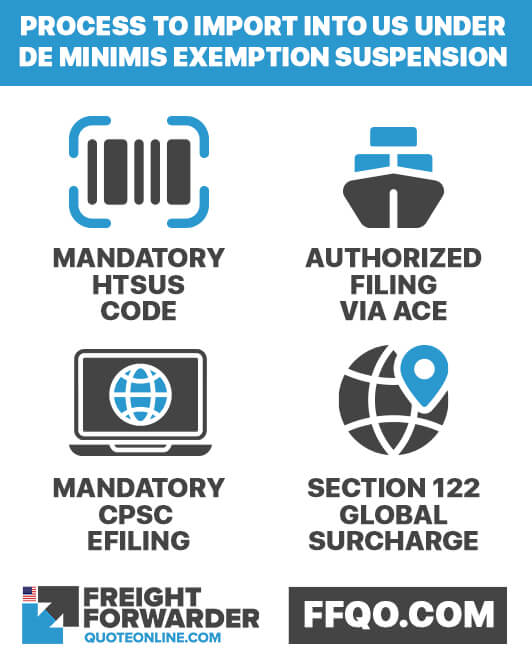
Process to import goods into the US under De Minimis exemption suspension
Contact Us
For any further information regarding how the De Minimis exemption suspension might impact your importing into the US, feel free to contact us. We are always ready to help. We can help advise and do all the customs broker work. Follow our LinkedIn Company page. Otherwise, check out our freight updates for imports and exporters to find more items about importing to the US.


