

Are you interested to know why there is transit time difference between LCL (less than container load) and FCL (full container load) shipments? Or are you looking for answers to the following questions:
- What happens in between an LCL’s travel that causes it to have longer transit time compared to FCL?
- Do LCL and FCL shipments follow a different route?
- What should I choose between the two?
We provide answers to these queries. Read on to learn more about LCL and FCL shipments.
Time difference between LCL and FCL route
Have you ever seen cargo loaded as LCL and FCL shipments before? Are you aware that the loading of the shipment types into containers is just the start of a long sea travel? It undergoes various processes that varies from one another.
This illustration below explains the time difference between LCL and FCL routes.
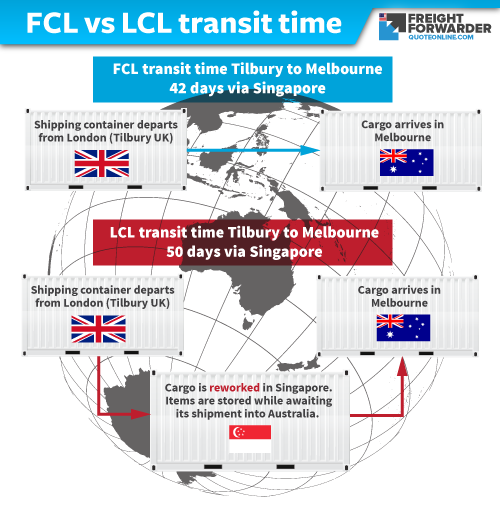
Transit time difference between LCL and FCL via Tilbury to Melbourne route
FCL route case scenario: London (Tilbury, UK) to Melbourne
FCL routes are pretty simple. Once your goods are loaded into the container, it is neither opened or reworked. It is directly transhipped to the destination hub port as agreed upon in your contract. Thus it typically takes only 42 days for FCL to arrive to its destination port.

FCL transit time from Tilbury direct to Melbourne is 42 days
LCL route case scenario: London (Tilbury, UK) to Melbourne
LCL shipments have many complex processes which includes:
- Dealing with more than one consignee
- Transporting goods to various ports
- Reworking for cargoes
These, together with other factors, causes a longer transit time as shown in this illustration:
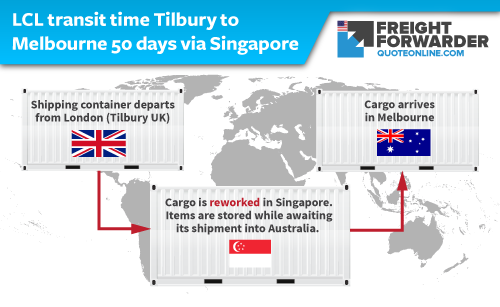
LCL transit time from Tilbury to Melbourne is 50 days via Singapore
LCL is composed of various shipments from different consignees. These cargoes go to different destinations, such as major sea ports in Australia like Brisbane, Melbourne and Sydney. However all of these goods will be discharged at a common hub port, for example Singapore, where the container will be reworked prior to it being shipped and distributed to their designated ports.

LCL route from London to Melbourne via Singapore
But wait! It doesn’t end here.
There are some instances where LCL cargoes have to wait for several days in a port for it to fill an entire container. Thus, rather than having the same transit time of 42 days for your goods from London to arrive in Melbourne; it may take about 50 days.
How are the small parcels for LCL shipments collected?
Here at Freight Forwarders Quote, we ensure that your parcels are shipped through the most reliable shipping lines. Our process comprises of these seven steps:
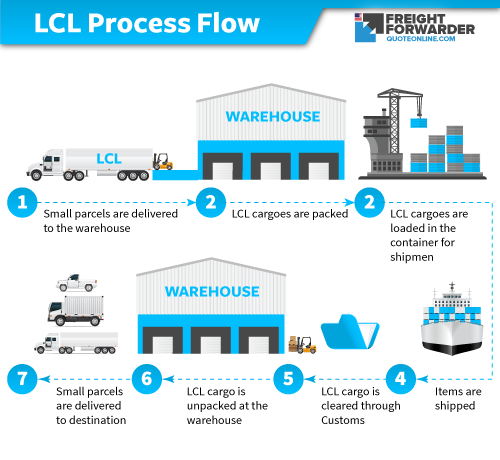
FFQO’s seven-step LCL process flow
We have long standing relationship with various shipping lines. We take good care of your cargo and ensure it has all the required Customs documents. Moreover, we offer competitive quote rates with no surprise fees. Use our online quote calculator to receive your free quote, today.
Factors to consider when choosing between LCL and FCL shipment
Generally speaking, you should consider these three points before choosing between LCL and FCL:
- Expected time of delivery
- Cost of freight
- Convenience
Did you know FCL can be cheaper than LCL when not a full load?
If your cargo is above 14 cbm (cubic meters), then it is smarter to choose FCL. However, if it is below 14 cbm then it is better to have it shipped via LCL, especially if you don’t have an urgent need for it to be shipped.

Weigh your options carefully, ” Should you choose LCL or FCL?”
If it is an urgent delivery, then it may be wiser to choose an FCL shipment or better yet inquire about FFQO’s cost effective air freight solution.
What type of cargo am I going to ship?
Fragile and valuable cargo should be shipped with extra care and caution: This includes:
- Marble, tiles, bricks, glass, bronze and stone articles
- Old furniture and paintings
- Laboratory materials and scientific devices
- Valves for radios and televisions
- X-ray equipment and neon valves
- Electronic, musical and optical instruments
- Photo and video cameras and their accessories
- Glass windows and discs
If you move these via LCL shipment, then it will be at higher risk of getting damaged in transit, especially if other consignments are not correctly packaged or packed into the container. Are you are willing to take this risk or would you rather have these items delivered in the best manner possible via air freight or FCL?
As a general rule, FCL is generally fast compared to LCL because of the less general handling and unforeseen delays. It is also great for cargo that require high security and fewer risks of damage.
On the other hand, LCL is a more cost effective solution for small volume shipments. This makes it the best option for businesses with smaller orders as it reduces inventory investment while providing more flexibility.
Freight Forwarder Quote Online helps you transport your cargo around the world. Talk to us for a free advice on how to best move your goods including warehousing, cargo consolidation, road transport to port, loading and unloading, and customs clearance documentations.
Want to know more about the different types of bill of ladings? Visit our article discussing this here.
Interested to learn beyond the transit time difference between LCL and FCL shipments? Read our published blog that discusses the advantages and disadvantage of LCL and FCL.
Contact us for help on the time difference between LCL and FCL
We have a large sea freight network worldwide and a full range of sea freight services. If you are looking for help on the time difference between LCL and FCL contact us online and send a message. You can even message us on Facebook for help on the time difference between LCL and FCL.


