

So you’ve decided to send cargo across the big water to another country and you are looking at air freight vs sea freight, eh? Let’s say, for example, that you’re shipping a load of Ramen noodles to Tahiti. You know how much they love those delicious and certainly gourmet soups!
The question you face is this – do I ship it, or book a seat for my pallets of noodles on plane?
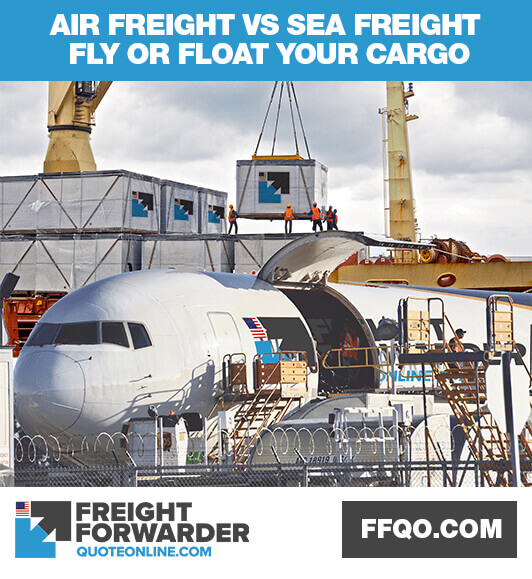
What is the better choice for import and export – airfreight vs seafreight
Kidding aside, this is an important question to answer. The short answer, when it comes to air freight vs sea freight, is that it depends on how urgent the need for the cargo is. If it has to be there by tomorrow… well, then air freight is certainly the way to go. On the other hand, if it’s not time-critical, then sea freight has many advantages, chief among them is that you’re not limited in size and the cost is far lower.
This article will break down the information you need to make an educated decision.
Looking at the sea options when comparing air freight vs sea freight
When you’re shipping by sea, the first thing you must do is to determine:
- What type of cargo you’re shipping?
- How much of it you’re shipping?
Knowing these two things is going to help you to determine the size of the containers, you’re going to need.
For instance, most of today’s cargo is containerized. You’ve seen these containers transported to and from the port. They look like tractor trailer box trucks with their wheels removed.
Standard sized containers vs break bulk cargo shipment
Standard sized containers are easily stored and stacked onboard a ship to maximize its storage capacity. But for goods that are too large to fit into any sized container, such as construction equipment and boats, you’ll need to ship them as break bulk cargo.
Full container load (FCL) vs less than container load (LCL)
Aside from deciding what type of container to use, you’ll also need to decide between LCL and FCL shipment, which we’ll discuss below.
FCL – Full container load
FCL is exactly what it sounds like – a container load full of goods, in this case, Ramen noodles.
Worried you may not fill it in with Ramen noodles?
Chill! There is nothing to worry. You aren’t required to use every cubic meter space because an FCL is owned by one shipper. This means it can be partially filled if desired. The main thing you need to know is that you are the sole owner of that container and you can fill it in or half-fill it with ramen (or other products for this matter). It’s your choice.
LCL – Less container load
It’s lovely to own an entire container all for your shipment. But if you only have enough Ramen to fill half of a container, then you can choose LCL.
You’ll be sharing the container with another shipper’s goods. That also means splitting the cost and making maximum use of the space available. This a great option especially for small to medium enterprises.
Transit time via sea freight
Of course, when it comes to sea freight, you have to be willing to tolerate a much longer shipment time than with air freight. To give you a rough idea, let’s say that you’re shipment of Ramen noodles to Tahiti covers a sea distance of about 3,000 miles. At an average speed of 15 knots, a cargo ship will cover 320 miles per day, or take about 8 days to reach Tahiti. Of course, there’s ground transportation on both shores as well as customs and so on to consider.
Looking at the air options when comparing air freight vs sea freight
Due to the faster and somewhat more reliable shorter transit time, air freight is certainly going to cost you more. But, depending on the urgency of the shipment this may not matter. Sometimes it’s worth the price to get something there quickly.
Couriers
You can use a courier company to handle your entire shipment. They do all of the work for you – booking with the airlines, customs paperwork and all shipping documentation. While certainly less stressful, this is a service for which you’ll pay a premium.
Direct booking
There’s nothing to stop you from booking your shipment directly with the airlines. It saves you time and money for certain. Of course, you’ll have to handle all of the logistics yourself.
Deferred / Direct services
Another option to consider when sending cargo overseas via air freight is how vital it is that the shipment go out immediately. Aside from direct shipping methods as mentioned above, you can also choose a deferred shipment plan.
In this scenario, your cargo is shipped at the discretion of the airlines. They determine the most convenient flights based on time, availability and lower tariffs that may be paid based on a particular airline. Although this does lengthen the transit time a bit, it can save you money.
Transit time via air freight
Obviously, shipping by air is fast, even with the deferred option, as compared to sea freight. Depending on where you’re shipping to, you can get cargo to its destination in as little as 24 hours. Commonly, however, expect a few days transit time because you have to factor in flight time, freight handling at both airports, customs inspections and so on.
How to calculate CBM
When shipping by sea, there are a few ways to calculate your cost. If you’re doing an FCL – full container load, then you simply pay by container. Break bulk cargo is charged based on the item and you’ll have to consult with the shipper. On the other hand, for LCL – less container loads, you must calculate the CBM – cubic meter or size of the cargo.
This is done simply by measuring the length, width and height of items to be shipped. For example, if your cases of Ramen noodles are 1 meter long by 1 meter wide by .5 meters high – then each case is half a cubic meter. If you have 1,000 cases, then your shipment has a volume of 500CBM, or cubic meters.
Note: All sea freight is measured in meters, so if you have measurements in inches and feet, you’ll have to convert.
Adam’s advice: Air freight vs sea freight
This topic is a common question we receive and the answer varies depending on several factors.
Realistically, it depends on your required delivery date. In most cases, if it is over 100 kg then it is more economical to send it via sea freight (of course there are exceptions).
While we use premium carriers in most cases, there could still be short delays in sea freight. However for a vessel falling behind 2-3 days in transit due to weather or port delays, this could be easily brushed aside. Only because we are considering the more economical rates it gives to your business. That is, if and only if, this is something your “customers” would deem “acceptable.”
Thus, in this economic climate, it is easy to airfreight your goods when struggling to meet delivery dates. However, when making these decisions, I recommend my customers to also consider the shipping companies they will be dealing with. Remember that shipping companies are also trying to reduce their cost and run in the most cost effective fashion. This makes it more prone to potential delays.
Feel free to send Adam a question. Connect with him in LinkedIn or use the online form from our contact page.


