

Are you aware that there’s an international shipping crisis happening right now in 2021? The most popular brands are being hit by price increases, up to a factor of 10, on the cost of transporting goods by sea.
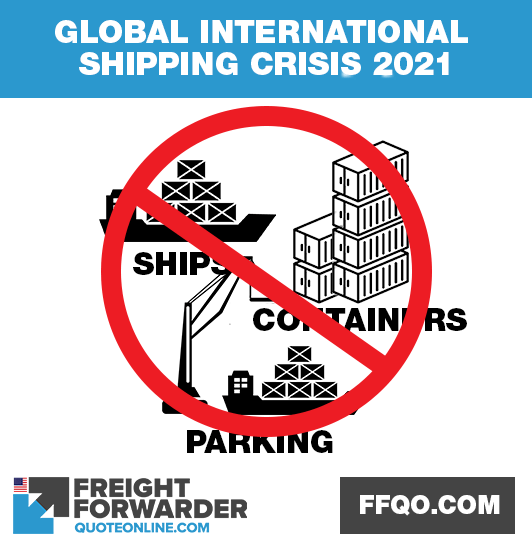
International shipping crisis 2021 is unfolding worldwide
International shipping prices are skyrocketing
Scarcity of basic commodities and production downturns are rife in offshore facilities. This turmoil in the shipping industry has been progressively rolling out, from the Covid19 breakout in early 2020, bringing chaos to every aspect of life and industry.
Looking at the pricing graph for a shipping freight carrier, it’s hard to believe one’s eyes – yet the data are correct. The Drewry World Container Index – shipping freight pricing index – has shot up by 282% in comparison to just 12 month ago.
The steep increase in shipping costs has brought about major shortfalls in:
- Semiconductors
- Lumber
- Chicken
- Chlorine

Shipping container prices in 2021 have increased by 282% from last year
What are the causes of the international shipping crisis
Virtually all goods and materials brought in from overseas have suffered. In 2020, Covid19 basically ruptured the logistics network and the cargo lines have yet to come back to normal. We are accustomed to an intricate worldwide web of transport and delivery systems. This system is why super-low-priced goods manufactured in Vietnam are delivered in two days, and seafood from America costs so little. (A lot of that American seafood is shipped to China for processing then freighted back to the US.) Sea freight makes it possible for us to purchase a plethora of low-cost goods.
Freighting goods by sea needs many things to function, namely:
- Many huge sea freight vessels
- Containers to store and hold the freight
- Locations where the vessels can moor, allowing them to be unladen
All these have been disrupted at some time over the last 18 months. Most, unfortunately, are not yet fully operational again See below for an explanation of how these disruptions occurred and why the fractures are not yet healed.
Ship shortage caused numerous cargo voyage cancelations
Global sea freight started feeling the pinch in the first part of Spring 2020. With the epidemic progressing worldwide it was hard to know whether manufacturing facilities in Asia would be operating. Further, it was moot whether people around the world would even be able to purchase the goods! On that basis, voyages began to be axed.
In March 2020 the freight companies were unsure whether they could fill their containers. They could not gauge the risk, which could potentially have meant a demand drop of 5, 15, 30 or 50 percent. It’s important to note that, for freight companies, profitability depends on their huge ships operating at below 100 percent capacity.
Because of this, the freight companies began to axe freight crossings. Up to 22% of their freight crossings between Asia and Europe were slashed by one leading operator. Relative to the Asia-North America market, some operators axed around 20% capacity.

First reason of international shipping crisis: no ships and upto 20% cargo voyages canceled
No parking so massive traffic jams developed at sea ports
Between a downturn in production and the foreshadowing of an economic crisis, global sea freight was brought to a shuddering halt in the first six months of last year. In the second half of the year, things were beginning to improve.
Instead of tightening their belts, people began buying, using money they’d been saving for holidays, eating out, etc. It’s well-known that hot sale items were home gym gear, lounge furniture and beauty products, and those buying biases are certainly keeping the US import landing locations busy! Indeed, the US’ largest port (by volume), Los Angeles, this year smashed it’s Q1 inwards freight record. And, in May, the second-largest, Long Beach, beat its own record. Such an increase in cargo amount has been a contributory factor to the huge gridlock in the port.
For the first six months of 2020, information from the Pacific Merchant Shipping Associated indicated less than 5% of consignments stayed in port longer than five days. That period did, however, extend as the year progressed. Over the October-through-December period, about 25 percent of vessels were held over longer than five days.
Just one month into 2021 there were around 55 ships thronging the LA and Long Beach seaports. These vessels had apparently been there for as long as two weeks. It was said by analysts that these vessels had traversed the Pacific in a shorter time than it was taking for them to be offloaded.
So why is it taking so long for these vessels to disembark their cargo? A major cause is the huge increase in market appetite. And US seaports are struggling with a lack of manpower. Many workers were affected by Covid quarantining last year. This has resulted in an acute shortage of dockhands to disembark the freight from the vessels and load it onto vehicles or railway transport.
In essence, any kind of problem with sea freighting creates a ‘domino effect’. A vessel whose cargo was offloaded late in LA is going to be late by at least the same amount of time when it returns to its port of origin to be reloaded with super-cheap goods. If the previous vessel was also late, the carrier might choose to release the vessel space it was to have been filling with cargo. Assuming that cargo had been ordered by a client in the US, that client will now have to try to get his order delivered to the US in some other way – and that, of course, impacts on his business and his downline supply chain. The impact continues, affecting everyone at every point, from point of origin right through to the end-consumer. And all the cargo orders/deliveries that follow are affected too, i.e. the ‘domino effect’.
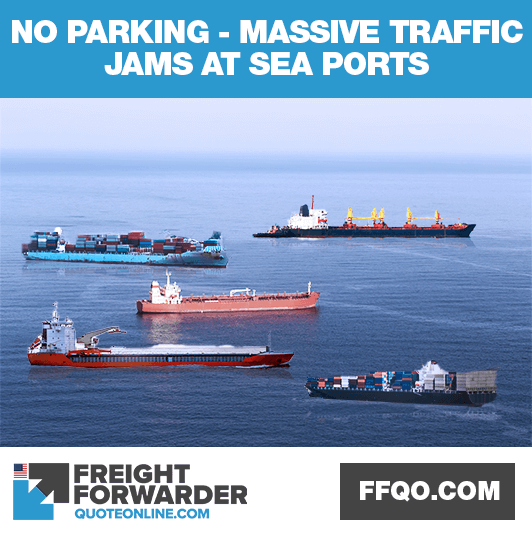
Second reason of international shipping crisis: no parking so massive traffic jams at sea ports
Poor shipping containers circulation caused shortage
Midway through 2021 conditions remain the same, and the scarcity of shipping containers is causing short supply of goods deliveries. More to the point, the shipping containers are in the wrong places. They may be in use on vessels, but many of those vessels are sitting out to sea, waiting their turn to move into the harbourage and be unloaded. The larger problem, however, is that a lot of these shipping containers aren’t returning to Asia for refilling.
US goods outwards are not equalling those coming in from China, which is the trans-Pacific country with which America does the most trade. Analysts report that the volume of goods imported from China via sea has risen 54% each year. Goods being sent out of the US have only increased by 4.4%. This tells us that there are huge numbers of shipping containers moving out of Asia, but a far lower number have gone back.
Only in recent times have shipping companies realized how important it is that empty shipping containers are carried back to point of origin for refilling. Fixing this disparity is still a work in progress. Authorities on the subject feel the problem will not be resolved before next year.

Third reason of international shipping crisis: poor shipping containers circulation caused shortage
Need help reducing impacts of the international shipping crisis?
We can supply holistic guidance on freighting cargo by sea. Through us, you can move your goods in a timely manner. Partnering with us, you are working with specialists who are renowned worldwide for their ability to get your cargo to where it needs to be, when it needs to be there. Feel free to contact us online or message via our Facebook page. We are happy to assist.


