

The Incoterms are a collection of terms used in contracts of sale that standardize many aspects of international trade and shipping. They include rules for how these terms are to be executed, providing a solid, effective framework to facilitate the many types of trade. Selecting the incorrect Incoterm for the trade and shipping of goods can result in frustrating confusion and costly delays for buyers and sellers. So making these terms clear and better for all parties to understand is vital in order to improve the industry.
The International Chamber of Commerce (ICC) currently revises the Incoterms every 10 years. The last update was published in 2010. Late last year the ICC published its latest version of the Incoterms for use from 1 January 2020.
The Incoterms 2020 is a major update of this framework and contains several key changes to some of its rules in order to reduce uncertainty and confusion. As the key changes are important, we have created this easy-to-understand summary.
 Incoterms 2020 – key changes you need to be updated on
What has changed in the Incoterms 2020?
There are six key updates to be aware of in the Incoterms 2020. They involve modifications to and additional information on trade terms, ensuring that these:
- Align with changes that have occurred on the freight industry
- Better explain each party’s responsibilities within some of the trade terms
- Strengthen conditions to better protect parties involved in the trade
DAT (Delivery at Terminal) becomes DPU (Delivery at Place Unloaded)
This term has not so much changed as refined, so it applies to a general set of circumstances. The word ‘terminal’ has been changed to ‘place’. This increases the flexibility of the term to cover the number of different types of locations where delivery can occur. The change of ‘terminal’ to ‘place’ also allows for clearer differentiation between DPU (Delivery in at Place Unloaded) and DAP (Delivered at Place).
 Incoterm DAT (Delivery at Terminal) becomes DPU (Delivery at Place Unloaded)
Dedicated section for costs in all terms to make things crystal clear
A dedicated section for costs is now included after the A9/B9 section for each rule. This is an improvement, allowing for buyer and seller to see more clearly at what stage of the process charges will be applied, as well as the full cost to be expected.
 Incoterms 2020 have dedicated section for costs in all terms to make things clear
Stronger security requirements to better protect cargo
Parties are now obliged to take more extensive measures to protect the security of cargo. The A4 and A7 rules have been updated to reflect this. They have been modified to include security requirements that affect carriage of the goods.
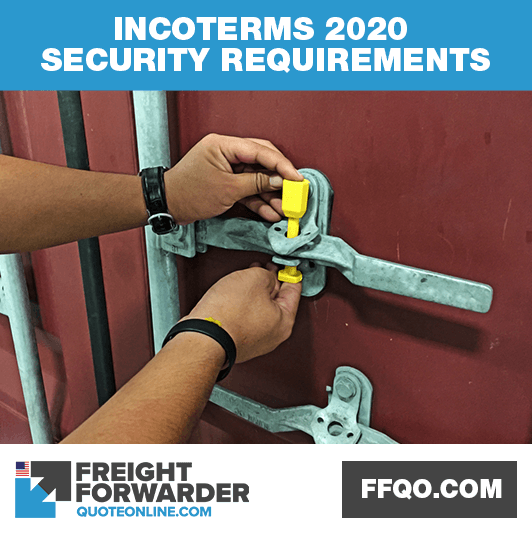 Stronger security requirements to better protect cargo
Improved insurance requirements for CIF and CIP
Cost Insurance and Freight (CIF) and Carriage and Insurance Paid (CIP) rules require different levels of insurance cover and are better clarified in the update.
- CIF requires insurance under Institute Cargo Clauses (A), which is suited to commodities
- CIF can, if desired, have higher levels of insurance if agreed to by the seller and buyer
- CIP requires insurance to comply with Institute Cargo Clauses (C), which is more extensive insurance suited to manufactured goods
The reasons behind this update are that CIF is widely used for trades in commodities, where a low level of insurance is more acceptable.
 Improved insurance requirements for CIF and CIP
Goods can be transported by seller or buyer
Previously the rules reflected that goods would be transported from a seller to a third party. That third party would then transport the goods to the buyer. The freight industry has changed now, whereby this does not apply in all cases. Sellers can now have the means to carry out the delivery of goods. Also, buyers can have the means to collect the goods. This change is covered under the D rules for sellers and FCA rules for buyers.
 Incoterms 2020 transportation via seller and buyer included
Bill of Lading option for Free Carrier (FCA) shipping
Many sellers were opting to use FOB shipping even when FCA shipping would be more appropriate because they wished to be paid under a Letter of Credit. This option was previously only available when FOB is used.
FCA and Free on Board (FOB) shipping have different delivery points. During FOB shipping, any risk associated with the goods is accepted by the buyer after loading. Essentially, buyers would take responsibility for stock before it arrived without any opportunity to check its condition. This is not a method that would be recommended for goods transported in containers.
Incoterms 2020 has now been amended so that, with agreement from both parties, a buyer can request transport documentation, such as an on-board Bill of Lading, to be transferred from the carrier to the seller during FCA shipping. The Bill of Lading can then be transferred through banks (if desired) to the buyer. This greatly improves the facilitation of trade via FCA.
 Incoterms 2020 Bill of Lading option for FCA
Need help on Incoterms 2020 when shipping to and from the USA?
If you need help on Incoterms 2020 when shipping to and from the USA, contact us online and send a message. You can even message us on Facebook.
We are an international freight specialist that has always given complete transparency when it comes to costs. Make sure you partner with an innovative and reputable freight forwarder that can be there for you when you need assistance.
Our international freight network for the USA has approximately 40,000 locations and can handle all your air and sea freight needs. So reach out if you need any help – we are happy to be there for you.


