

The United States is forming an international consortium with United Kingdom, Canada, Australia and New Zealand competition agencies to identify global supply chain cartels. The forming of the international consortium has resulted from a number of investigations into the global shipping fraternity over the last several years.
Included in the task force are the:
- ACCC (Australian Competition and Consumer Commission)
- CCB (Canadian Competition Bureau)
- NZCC (New Zealand Commerce Commission)
- UKCMA (United Kingdom Competition and Markets Authority), and
- US DOJ Department of Justice Antitrust Division.
The purpose of the consortium is to boost global partnering with these agencies to dramatically improve their ability to conduct competition enforcement. The focus between the agencies include activities such as:
- Investigation cooperation
- Working on joint projects
- Sharing training initiatives
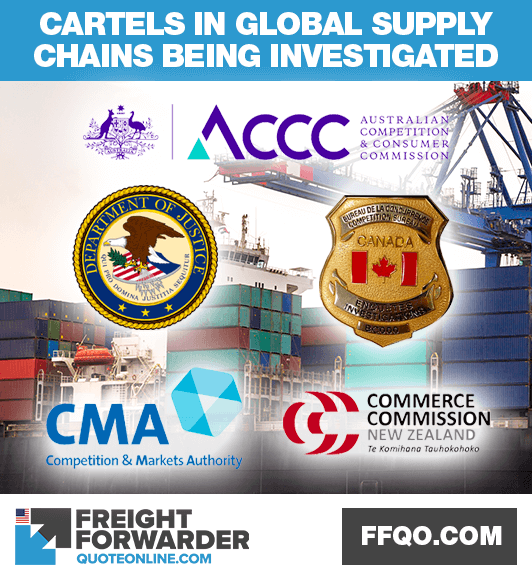
Global supply chain cartels being jointly investigated by US and other competition agencies
What are cartels in business
A cartel is where two or more businesses agree not to compete with each other including. This is done when members of the cartel agree on goods and services in common between these to do any of the following:
- Fixing of prices and rigging of bids
- Collaborated allocation of markets or customers
- Co-ordinated restriction of outputs or acquisitions
Cartels in business harm consumers by preventing other businesses that are trying to compete fairly and being able to provide better quality services at better prices. It can include competitors agreeing on pricing and pricing intentions, allocating markets or customers, or restricting the output of goods or services where it is not necessary in the current situation. Many governments have recently prohibited business cartels and made them punishable with long term imprisonment.
Pandemic ideal for global supply chain cartels
The pandemic has caused restrictive and disruptive conditions perfect for the development of cartel conduct. Anna Rawlings, chairperson of New Zealand’s Commerce Commission, said that pandemic-related global supply chain cartels have caused major problems for markets worldwide. The Commerce Commission does not tolerate unprincipled organizations using the pandemic as an opportunity for anti-competitive behavior. As an example, competitors colluding unnecessarily and utilizing monopolistic working practices were cited.
The multinational consortium will further escalate its ongoing work to obviate and punish cartel behavior. Anna spoke of the range of educational initiatives the New Zealand Commerce Commission was undertaking as a member of the international consortium. These are intended to increase business’ knowledge of cartel behavior, and raise awareness of its consequences.
Closure of International Council of Containership Operators
Knowing there was growing disapproval and conjecture, shippers decided last year to disband the International Council of Containership Operators (ICCO). This highly secretive association was composed of CEOs from the leading shipping lines of the world. The activities of the ICCO members triggered an antitrust probe by the US Department of Justice (US DOJ). The ICCO was disbanded in 2021 after operating for almost 50 years.
Secretive group for shipping chief executives
Established in 1973, the ICCO met twice a year. It never revealed the time and location of those meetings publicly, nor did it make minutes of the meetings available. Maersk commented that the ICCO was an invaluable assemblage for its members, who were at the highest level of responsibility for the policies and actions of their companies. In this forum they could gather to share and discuss non-business intelligence to ease and assist long-range planning within the shipping industry.
Soren Skou, CEO of Maersk and ICCO chairman from 2014 to 2020, said the ICCO had made a hugely important contribution in the history of the maritime industry. He added that the ICCO history will be drawn upon as the industry moves forward. What Soren meant by this in how exactly it would help move the industry was not stated. Michael Scanlon, a K&L Gates LLP partner acted as counsel to the ICCO. In the statement, Gates said the ICCO is no longer needed because there are now many relevant forums through which the maritime industry can deal with critical matters.
Subpoenas to group members first serviced in 2017
During a March 2017 meeting of the ICCO in San Francisco, a raid was conducted. The US DOJ served subpoenas on the members in relation to a probe into price-fixing. Some of the shippers who affirmed they had received summons were:
- Maersk
- Mediterranean Shipping
- CMA CGM
No charges or penalties from investigations so far
Over the two years, the US DOJ conducted an inquiry into collusion between the main shipping companies in the world. This investigation ended in February 2019. There were, however, no charges brought or penalties imposed.
With the pandemic, however, there has been increasing numbers of claims of collusion and exploitation. These suspicions have been raised by major shippers raking in huge unprecedented profits. US, European Union and Chinese administration officials came together last September to evaluate these claims. Presented evidence suggested monopolistic practices did appear to be a problem in the shipping industry.
It should be noted that, over recent years, some shipping cartel inquiries, particularly in the car carrier category, have culminated in hefty fines.
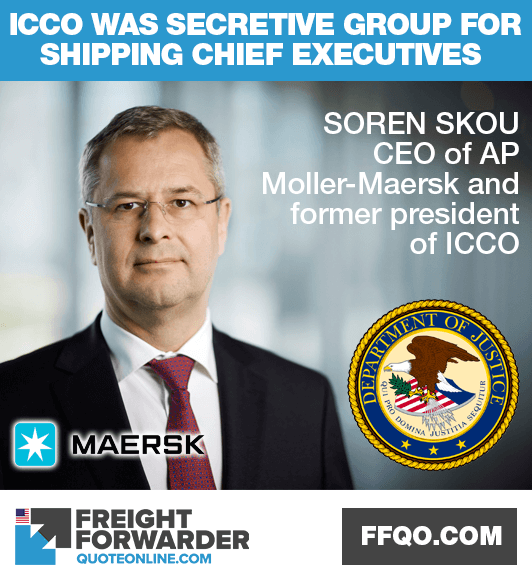
ICCO shipping chief executive secretive group with Soren Skou as former president who is CEO of AP Moller-Maersk
Regulation and monitoring for global supply chain cartels overdue
Olaf Merk of the Organization for Economic Co-operation and Development (OECD) said that the time for coordinating, tracking and policing shipping to stop global supply chain cartels is way overdue. Olaf is the project manager for ports and shipping at the International Transport Forum (ITF) of the OECD. Although shipping is worldwide, there is no universal regulation of competitive practices. Olaf said he believes the international consortium of competitor agencies will assist in ensuring fair competition of global supply chains continues.
James Hookham, a Global Shippers Forum director, addressed the news that, like shippers, economic regulators worldwide are concerned by the behavior of markets. Hookham says the announcement of this is both welcome and well-timed. He says shippers need to take this as an alert. It foreshadows how charges and capacities may change as the global economy comes out of the pandemic and markets normalize.
Looking for some help to avoid global supply chain cartels
Our air and sea freight network to and from the US connects several hundred suppliers and covers tens of thousands of 40,000 locations. We can help you organize your supply chain around independent operators and help avoid the cartels in the global supply chain and shipping. Our freight forwarding services are transparent with no hidden costs. Feel free to contact us online and send a message, or message us on Facebook.


