

Are you familiar with the terms ‘dimensional weight’ and ‘volumetric weight’ for LCL shipments? Do you know how to calculate the chargeable volume of your LCL shipment? Are you lost on how freight forwarders charge their LCL freight shipment? If not, this is for you.
Why is there a need to compare the gross weight and volumetric weight of your LCL shipment
The only way you can compare gross weight with the volume of a LCL shipment is by calculating its weight-based volume (volumetric weight). This is necessary because there are times when a cargo can be bulky. That is, they take up a lot more space than the average weight of shipments with the same volume. Consider how cotton and steel compare with their ratio of weight to the volume of space that takes up.
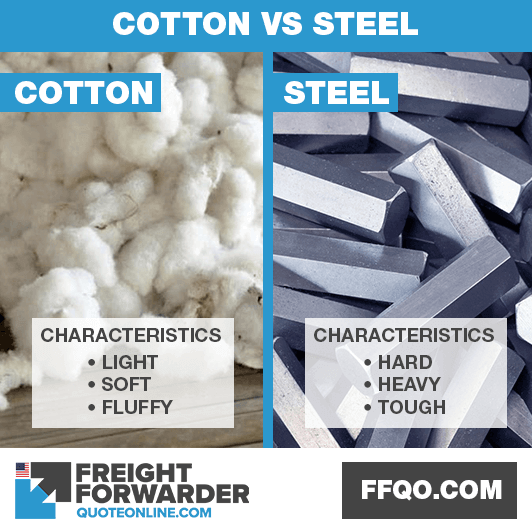
Comparing the difference in volume and weight of cotton to steel shows how this factor needs to be allowed for when it comes LCL shipping
How to calculate chargeable volume of LCL shipment and volumetric weight
So how do you calculate the chargeable volume of an LCL shipment?
To begin your chargeable volume calculation for sea freight, you should already know the following measurements for your packaged goods:
- Length (l)
- Width (w)
- Height (h)
- Gross weight
Chargeable volume formula for LCL shipment
It is important to note that volumes and weights must to be in metric for the following calculations.
The following formula is used to calculate the chargeable volume of LCL shipment.
Weight-based volume (volumetric weight) = Actual weight / 1000
Gross volume = (L x W x H) /1000

Chargeable weight becomes the greater value between weight-based (volumetric weight) and gross volume
Let’s consider this formula, using the below examples.
LCL Shipment: Gross volume greater than weight-based volume
In this particular scene the gross volume of the LCL shipment is higher in value than the weight-based (volumetric weight) volume. This makes it the chosen chargeable volume for the cargo.
Shipment measurement
- Length (l) = 40.16 in
- Width (w) = 38.58 in
- Height (h) = 41.73 in
- Gross weight = 1653.47 lb
Calculation
Step 1: Calculate the volume of the shipment
Volume = length x width x height
= 40.16 in x 38.58 in x 41.73 in
= 64,655.33 cubic inch
Step 2: Convert the result into metric measurement in meters
To convert cubic inches into cubic meters, follow this formula: 61,024 cubic inches = 1 cbm
64,655.33 cubic inch = 1.06 cbm
Step 3: Calculate the weight-based volume
To calculate the weight-based volume we need to continue with our calculation, following the below formula:
Weight-based volume = Actual weight (kg) / 1000
There is, therefore, the need to convert pounds into kilograms by following this formula: 1 lb = 0.4536 kg
Thus 1,653.47 lb = 750 kg
You can now proceed with the weight-based volume calculation.
Weight-based volume = Actual weight (kg) / 1000
= 750 kg / 1000
= 0.75 cbm
Step 4: Compare the weight-based volume
Gross volume vs Weight-based volume = 1.06 cbm vs 0.75 cbm
Chargeable volume is the greater value, which is 1.06 cbm.
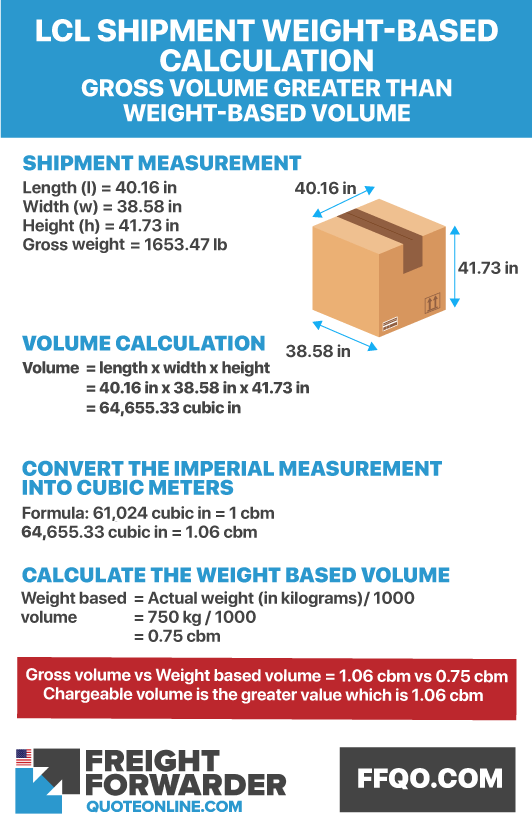
How to calculate chargeable weight if gross volume is greater than weight-based volume
LCL Shipment: Gross volume less than weight-based volume
There are instances when the weight-based volume of the cargo is less than the actual volume. In these cases, the value of the gross volume becomes the chosen chargeable volume for the LCL shipment.
Shipment measurement
- Length (l) = 47.25 in
- Width (w) = 63 in
- Height (h) = 45.28 in
- Gross weight = 12,000 lb
- Number of boxes = 2
Calculation
Step 1: Calculate the volume of the shipment
Volume = (length x width x height) x 2
= (40.16 in x 38.58 in x 41.73 in) x 2
= 129,310.65 cubic inch
Step 2: Convert the result into metric measurement in meters
To convert cubic inches into cubic meters, follow this formula: 61,024 cubic inches = 1 cbm
269,574.48 cubic inch = 4.42 cbm
Step 3: Calculate the weight-based volume
To calculate the weight-based volume, we need to continue with our calculation using the following formula.
Weight-based volume = Actual weight (kg) / 1000
The pounds need to be converted into kilograms by following this formula: 1 lb = 0.4536 kg
Thus 12,000 lb = 5,443.11 kg
You can now proceed with the weight-based volume calculation.
Weight-based volume = Actual weight (kg)/ 1000
= 5,443.11 kg / 1000
= 5.44 cbm
Step 4: Compare the weight-based volume
Gross volume vs Weight-based volume = 4.42 cbm vs 5.44 cbm
Chargeable volume is the greater value, which is 5.44 cbm.
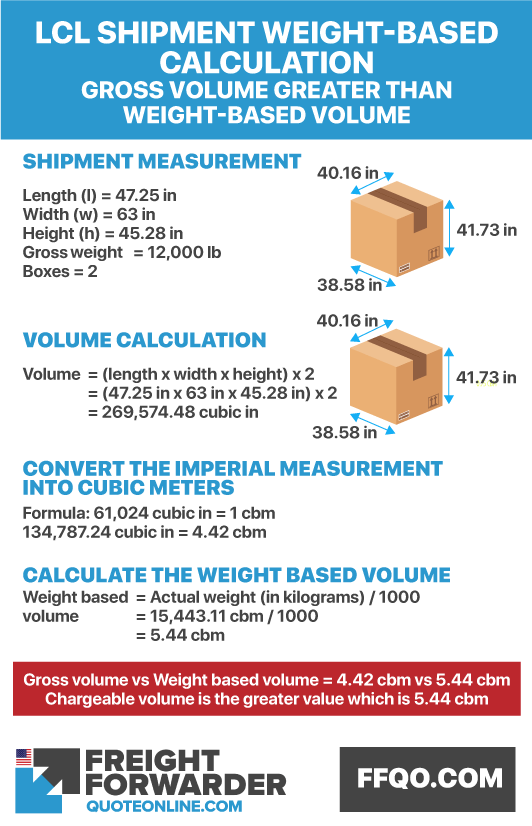
How to calculate LCL chargeable weight if gross volume in cbm < weight-based volume
How to calculate the chargeable weight of an irregularly-shaped items
There are instances when the item to be shipped is irregular in shape. How is this to be calculated?
It is calculated in the same manner; however you need to know your shipment’s correct measurements. Take the longest, widest and tallest measurements for the object, to get the length, width and height. Imagine the smallest box that would fit the item and that, according to the freight forwarder, will be considered the volume.
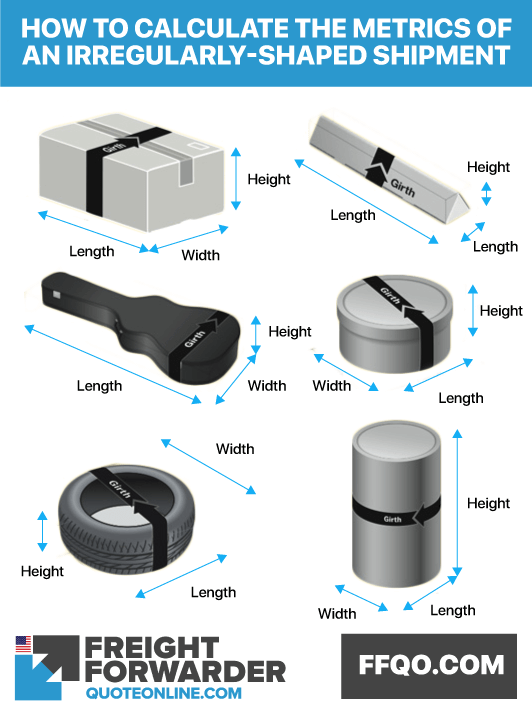 How to calculate chargeable weight of irregularly-shaped objects for LCL
After listing the measurements, you may now use the formula for LCL freight as discussed above.
Do you need assistance moving your goods either via air or by sea? We are happy to help you. Use our easy to use online quote tool otherwise, send us a message for assistance.
Do you need help calculating your airfreight chargeable weight? Read this article.
Contact us if you need help with volumetric weight
Our forwarding network from the USA has more than 40,000 locations around the globe for international sea freight. We run a lean and transparent sea freight forwarder service, so contact us online and send a message. You can even message us on Facebook for a quote on doing your air freight to and from the USA.


