

Making sure you are using an effective set of bill of lading guidelines and best practices will help prevent exposure of your business to unnecessary risk. This document is the most critical of all when importing and exporting cargo. A bill of lading details the nature, quantity and condition of the goods; the terms of the contract; acts as the title of the goods and as a receipt.
The holder of the bill of lading has the legal rights to claim the goods or transfer ownership to another party. For example, the carrier passes the bill of lading to the shipper as evidence that the goods have been delivered.
 Bill of lading guidelines and best practices
Important guidelines when handling bills of lading
As this document is a contract, it is paramount that information within it is correct to prevent exposing your business to unnecessary risk. It is also important to understand that this document will change hands a number of times during shipping, so there must be robust processes in place to receive the goods and verify documentation.
It is critical that only one set of lading documents be generated. It is vital that no or unclear instructions are never accepted.
Before signing a bill of lading
Essentially the document needs to be complete and accurate. It is important to note that companies have faced prosecution for misleading and deceptive conduct in respect of inaccurate documentation.
Details are correct
Please take care to ensure the following details are correct, including date of shipment, name of vessel and port, shipper name and consignee name.
Cargo in order
Sight evidence that goods are loaded successfully (mate’s receipt) and are in good condition and undamaged. Also ensure that the cargo has the correct quantities and any shortages have been noted.
Check clauses
Make sure you check if required clauses are included if they are necessary and lawful, such as that prepaid freight payment has been received. If the vessel being used falls under a charter party, check that the cargo owners’ rights to their goods are preserved and required terms, conditions and exceptions are present.
In demurrage details, check if it is agreed that loading time and discharge of delivery time can be combined or should be ‘endorsed’ in the bill of lading.
Watch for terms such as “said to be”, “said by shipper to be” or “said by shipper to contain”, as these are likely to void any call on a letter of credit or insurance claim.
Note discrepancies
To cover yourself when you sign the bill of lading, there are some important notes to make on it as part of the process.
- If the weight of quantities is not shown on the billing of lading, then list ‘weight and quantity unknown” alongside figures
- While not recommended, ‘unknown’ can be used when describing contents or value if this information is not available
- If there is a difference in amount between what is recorded as delivered versus loaded, both quantities should be noted
- If you only know the ‘apparent condition’, note this, otherwise “good condition” or details of damage should be noted
 Things to do before signing a bill of lading
Accept only original documentation
Under no circumstances accept faxed or photocopied bills of lading or guarantees.
Only act upon receipt of original documents.
 Only act upon receipt of original documents
Ensure no outstanding payments
Ensure you collect any charges due to you before releasing goods. Do not let any debate or argument about such costs blind you to the absence of the bill of lading or incomplete paperwork.
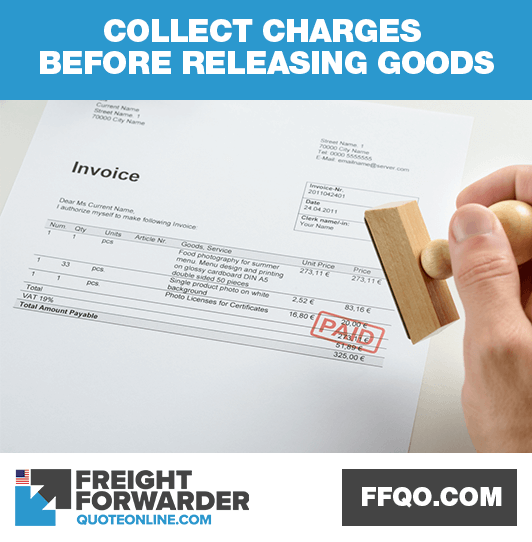 Ensure you collect any charges due to you before releasing goods
Ignore external pressure
Do not succumb to any commercial pressure to release goods without the appropriate documents. Examples of situations where external pressure can occur are when:
- Deliveries are late, or last delivery of the day
- Management not available for irregular release
- Maintenance issues or emergencies reported by the transporter
Ignore the pressures in these situations: remain diligent and stay with your process.
 Do not release goods without proper documents
Bank guarantees used in place of bill of lading
You may be requested to accept a bank guarantee in place of a bill of lading. Examples of when this could occur when the:
- Bill of lading is missing and delivery or payment is required
- Goods are being discharged at a different location than originally planned.
As a rule, when developing a set of bill of lading guidelines and best practices, it should state that bank guarantees should not be accepted. Instead, in this situation, it would be necessary to follow your company’s irregular release procedure.
Make sure you involve a member of your company with adequate authority to review the bank guarantee and accept the conditions.
The document has been reviewed and approved by your insurance company. You must advise your insurer of your intention to accept a bank guarantee, as not all insurance companies cover this circumstance.
We recommend the following also be checked:
- That the document is an original and not a copy
- Indemnity provided by the bank guarantee covers all parties
- The bank offering the guarantee can under a worst case scenario:
- Financially meet the potential cost
- Is not at risk of insolvency
- The guarantee covers an adequate time period, typically two years.
Why is this so important?
If a bank guarantee is not adequate, or insurance coverage is rejected, the business can be exposed to considerable financial risk. Businesses have fallen victim to fraud when a bank guarantee has been used to obscure that the condition and quantity of goods has changed, or the terms are written to favour one party over the other.
 Using bank guarantees instead of bill of lading
Implement explicit and adequate training for staff, whereby only an authorized team member can approve regular releases.
Do you have questions on your bills of lading?
We are happy to share our experiences in making this list of bill of lading guidelines and best practices. If you need help on bill of lading guidelines and best practices when shipping internationally to or from the USA, contact us online and send a message. You can even message us on Facebook for assistance. We have much expertise and are here to help.
If you need help with importing or exporting, feel free to contact us. Eliminate unnecessary delays and reduce business risk by partnering with an experienced and reputable freight forwarder like us. We pride ourselves on delivering, in a timely fashion, quotes that take your specific needs into account so that there are no surprises later on. Whether you are importing to the US or exporting, we can help you have a hassle-free experience.


