

US shipping is about to be transformed and 3D printed spare parts for ships will soon be available. It will be a watershed moment to be able to get spares at any main port, or from the vessel’s onboard workshop, in just a few hours.
Utilizing state-of-the-art 3D printing techniques to create spare parts is termed as ‘additive manufacturing’ (AM). Its use for spare parts for vessels is the method of commercial trialling with maritime freight organizations. In 2020, Berge Bulk got and utilized some passive 3D printed spare parts, and ConocoPhillips Polar Tankers trialled using dynamic components in 2021.
3D printed spare parts for cargo ships coming to US marine industry
Starting with passive parts like scupper plugs
Utilization of this methodology has been steadily gaining ground for a while, and is achieving some importance. There are enormous possibilities for saving of time, money and impact on the environment in 3D printing to make marine spare parts. Berge Bulk is taking part in this ground-breaking undertaking to produce 3D printed components and ascertain whether this production method is a viable option compared with the hitherto common methodologies.
In February 2020, Berge Mafadi, a large Berge Bulk cargo carrier, was a trailblazer, taking delivery of 3D printed spare parts from Whelhelmsen Ships Service. The consignment included stoppers utilised for closing off drain and discharge outlets to preclude oil or other spillages on board.
Such stoppers exemplify the numerous benefits of 3D Printing. Being inexpensive and with no common measurements, if, for example, a new stopper is needed urgently it can be quickly and cheaply produced, on the spot or nearby, via 3D Printing.
Berge Bulk’s stoppers are often stolen because they are made with brass. Replacing them is a costly matter. Using plastic replacements the risk of pilfering is nullified, and there is the huge benefit of the components being available as and when required.
Currently testing active parts like gears
In February of 2021, 3D printed and fully tested dynamic components were installed on the container ship Polar Endeavour. There were a number of primary players involved, such as ABS, ConocoPhillips Polar Tankers, Sembcorp Marine and 3D Metalforge. After being in service for six months, the components were removed and subjected to inspection by the ship’s men. Following this the components underwent over-the-horizon examination and were approved by ABS.
Three components were included:
- Gear set and gear shaft for boiler fuel supply pump
- Flexible coupling for marine sanitation devices pump
- Ejector nozzle for fresh water generator
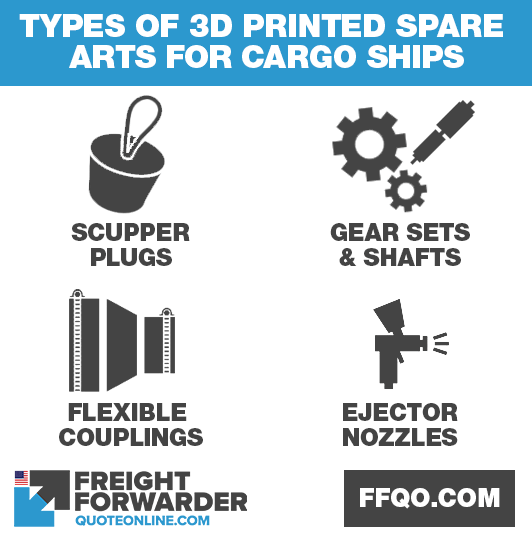
Types of 3D printed spare parts for cargo ships
How 3D printed spare parts for ships differ from traditional ship part making
Historically, the components utilised in ship manufacture and reconstruction are made by forming or moulding. 3D printing creates items through layering the substance time and time again. This methodology allows goods and parts to be made in close proximity to, or possibly on, vessels or on deep sea installations and facilities. This lowers production and wait times for unique and/or complex components, and makes for greater productiveness through creative planning, shorter production time and enhanced access to componentry.
Digital inventory of 3D printed spare parts for ships required
One of the characteristics of 3D printing that endear it to the maritime transport sector is that it can be used to replicate unique configurations from innumerable discrete substances, utilising a number of specialised methods – and this can be done as and when required. The main requirement, besides the 3D printing machinery, is the digital datafile for the required component. To produce the components quickly, however, 3D printing companies need to gather a large array of digital datafiles covering commonly-used components.
Thousands of spare parts to digitize
In the years ahead, it is believed over 50,000 discrete components will be digitally created and thus able to be provided to customers as required. This will negate slow and expensive warehousing, transportation, customs and collection operations. In order to have a centralized network of components available as required, a cloud-based catalog is essential. Creating such a repository of 3D files is a huge undertaking. In order to ensure precisely the same components are received at various different locations, where different technology or materials may be used, means some adjustments the instruction datafiles or preparation work will need. This can entail using a number of datafiles for the particular component. By using a number of datafiles for the same component, the digital inventory will be expanded considerably
Part tracking to support quality control
Wilhelmsen, Ivaldi and DNV GL are trialling a global tracing network to underpin QC, support development and monitoring. Applicable information and necessary data relative to the drafting, making and operational needs of every component are recorded and every piece is provided with discrete identification coding. A full record of all data is being built, ensuring identifiability and that each component is verified as fit for purpose. This will be scaled as necessary.
Replacing single part instead of whole unit
In the event of a component breaking, the transport organisation can simply exchange that component rather than the entire piece. This provides a wonderful solution not available via historical practices. A further advantage is being able to refine and enhance components according to user knowledge learned experientially.
More critical 3D printed spare parts for ships to come
Initial listings of 3D-printed parts accessible via 3D printing companies may appear unremarkable. The ability to access these components as and where required, at major ports – and eventually at all main ports worldwide – will be a gamechanger for cargo companies. This is already apparent from the list of organisations moving to adopt this technology.
It’s inevitable that this technology will soon be used for items with more complexity. Due to materials being costlier, the cost of a 3D-printed spare part may be greater than the base version, yet even then savings will be made on the overall costing. Also, big pluses are the speed at which components can be delivered and the benefits to the ecology.
For the producer, it is both time and cost-effective to digitally transmit an invoice for a datafile than to freight a physical item. This method also does away with the amount of time, energy and manpower involved in reengineering a production line for just one item.
Improved reliability and lower operating costs for cargo ships
Freight Forwarder Quote Online utilises large container ships for marine shipping – this is our stock in trade. We are excited about the future that includes the marvels 3D printing of spare parts for ships. The advantages this brings and the differences it can make will be extraordinary!
Based on all we know about these developments, we’re looking forward to greater dependability in delivery times and reduced operational outlays for container shipping. If you need some cargo using ocean freight, let us quote for you. Feel free to contact us online or message via our Facebook page.


